
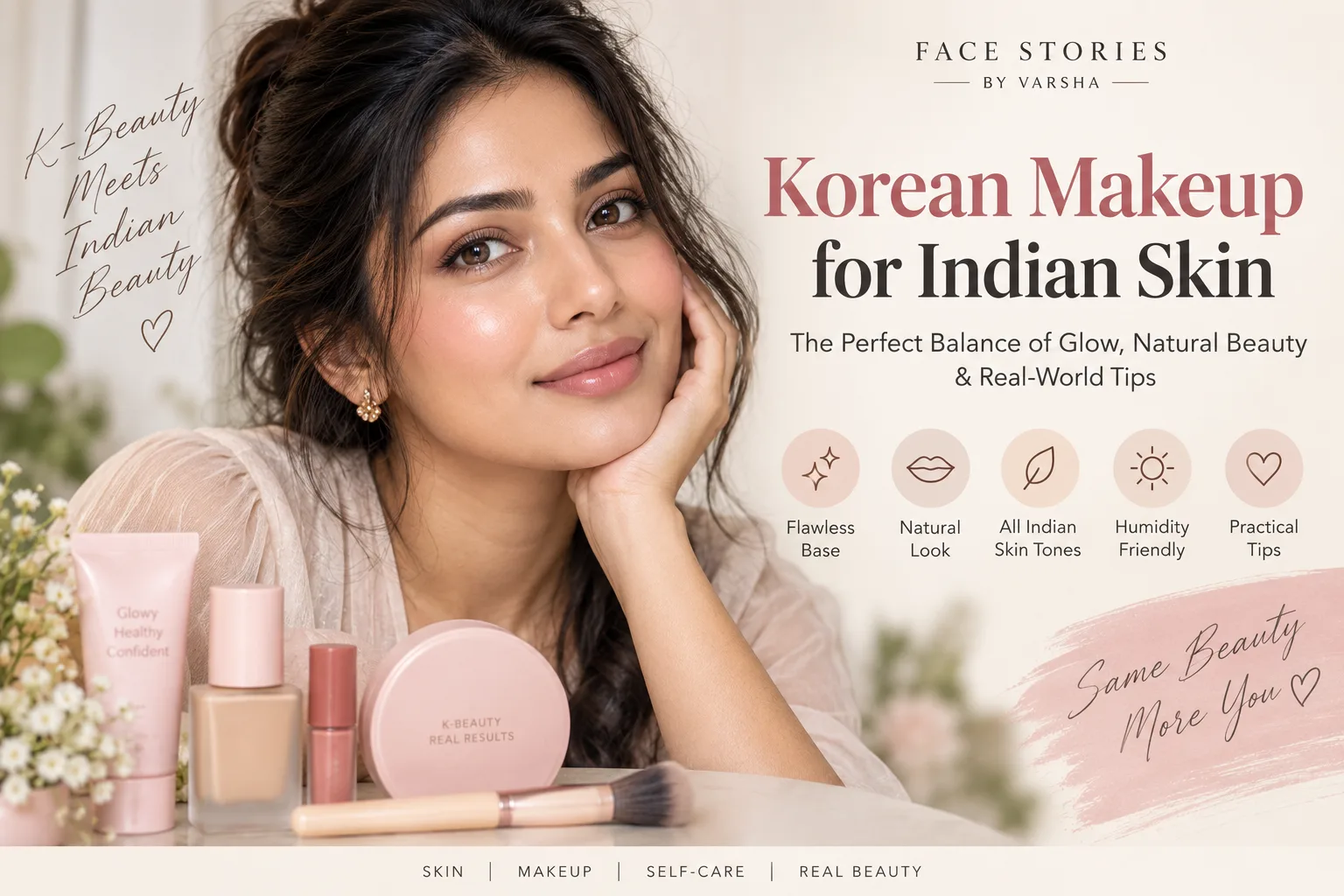
Korean makeup and Indian skin get along better than most tutorials suggest, once you adapt the technique to your undertone, your skin type and the weather. The Korean approach starts with the skin: prep it well, then build a thin, luminous base that lets it show through.
In Chennai, that approach runs straight into heat and humidity. The classic glass-skin routine needs honest adjustments before it survives an Indian summer without turning into an oily film. This guide walks through the principles, the product logic, and the step-by-step method a professional makeup artist would use, with the adaptations that make it work on Indian skin.
What Is Korean Makeup?
Korean makeup is a style built on skin-first preparation and thin layers of product. Instead of full-coverage foundation, it leans on hydration, cushion foundations, BB creams, cream blush and a soft, blurred finish. The goal is a complexion that looks healthy and naturally lit, the look often called ‘glass skin’, rather than obviously made up.
Three principles drive everything:
- Prep beats coverage. A hydrated, even canvas needs far less makeup.
- Thin layers build a believable finish. Product is added gradually where it is needed.
- Cream and liquid formulas. They melt into skin and sit better on warm undertones than powder-heavy layers.
The techniques translate well to Indian skin. What changes is product texture, colour placement and finish control in humid weather.
Understanding Indian Skin Tones and Undertones
Indian skin covers a wide range of tones, from fair to deep, and the undertones vary just as much: warm or golden, neutral, olive and sometimes cool pink. Two people can share the same tone yet have different undertones, so a Korean makeup base should be chosen by undertone first, depth second.
You can read your undertone at home. Check the veins on your inner wrist (green-blue usually reads warm, blue-purple cool), or hold a white paper against your jawline and see whether your skin leans yellow, pink or grey. Products that match your undertone disappear into the skin. Products that fight it leave a grey or chalky cast.
Adapting the Look by Skin Depth
- Fair skin: Dewy bases sit easily, but sheer Korean cushions can wash you out. Look for a shade with a touch of warmth rather than a flat white.
- Medium skin: This range has the widest shade availability. Warm-neutral cushion shades and terracotta blushes blend naturally.
- Dusky skin: Choose deeper, golden or bronze-tinted bases and cream blushes in berry, brick or copper tones. Powder-heavy looks turn ashy fastest on this range, so cream products matter most here.
- Deep skin: The dewy finish is flattering, but only with the right depth of base. Test foundation along the jawline, not the hand, and lean on high-pigment cream blushes and bronzers that show up on rich skin.
There is a consistent rule here: the deeper the tone, the more important cream textures and pigmented shades become.
Adapting the Look by Skin Type
Korean makeup is not one-size-fits-all. Your skin type decides where the dew goes and where it does not.
- Oily skin: Keep the base water-based and mattify strategically. Prime the T-zone, set only the forehead, nose and chin with translucent powder, and keep the dewy finish off the nose entirely.
- Dry skin: Hydrate generously before makeup and lean fully into cream products. Powder, even translucent, can catch on dry patches. Use it only if you need it, and prefer a setting spray over powder where possible.
- Combination skin: Treat the face in two zones. Mattify the T-zone, keep cheeks dewy, and adjust both choices as the day and season change.
The One-Paragraph Answer: How Do You Get a Natural, Dewy Korean Look That Lasts in Indian Heat?
Prep your skin with a lightweight hydrating routine, apply a water-based or cushion base in thin layers, place cream blush and highlighter on the high points, set only the T-zone with translucent powder, and finish with a setting spray. Carry blotting paper and press, not wipe, when you need to manage shine. The dewy finish lives on the cheeks while the oily zones stay matte.
Choosing Products: The Selection Logic
You do not need Korean-brand products to do Korean-style makeup. You need products with the right finish and texture for your skin.
- Base: cushion foundation, BB cream or skin tint with a natural-to-dewy finish. Choose water-based formulas in humid weather; they sit lighter and slide less.
- Concealer: thin and hydrating, one or two shades lighter than your base at most.
- Blush: cream or gel in a shade that reads as a natural flush on your undertone. Peach and terracotta for warm, soft rose for neutral, berry for deeper tones.
- Highlight: cream or liquid, tapped on cheekbones and the bridge of the nose. Powder highlighters can look glittery on textured or oily skin.
- Powder: translucent, used only where you get oily. Powdering the whole face is the easiest way to kill the dew.
Whether a product is Korean or not matters less than its texture and finish. A water-based cushion or BB cream from any brand works if the shade matches your undertone and the finish is dewy rather than matte.
Step-by-Step: Korean Makeup for Indian Skin in Hot Weather
Step 1: Start With Skin Prep
Prep decides how the rest of the look behaves. On Indian skin it has three jobs at once: hydrate, calm and control oil. Cleanse gently, then follow with a hydrating toner, a light moisturiser or gel cream, and sunscreen. In humid weather choose a gel or water-based moisturiser rather than a heavy cream so your base does not slide off.
Wait three to five minutes after moisturiser before applying makeup. Products grip better on skin that has absorbed its skincare than on skin still wearing it on the surface.
Step 2: Use a Light, Water-Based Base
Skip full-coverage foundation. A cushion foundation, BB cream or skin tint gives the ‘my skin but better’ finish. Apply in thin layers with a damp sponge, bouncing product into the skin rather than dragging it. Build coverage only where you need it, around the nose and any redness, and leave the rest light.
On oily skin, use a mattifying primer on the T-zone before the base, and leave the cheeks un-primed so the dew survives there.
Step 3: Spot-Conceal Instead of Covering Everything
Conceal only what needs it. Under the eyes, around the nose, and any marks. Use a thin, hydrating concealer and blend with a fingertip or a small sponge. The goal is even tone, not a painted-over face.
Step 4: Cream Blush, Placed High and Soft
Cream or gel blush is the signature of the Korean look and it flatters Indian skin without looking chalky. Apply a small amount to the apples of the cheeks and blend up and out toward the temples. Match the shade to your undertone (peach, terracotta or soft rose) and build the colour gradually. A common mistake is pressing the blush too low on the face, which drags the look down.
Step 5: Soft, Natural Eyes
Korean eye makeup is gentle: a wash of neutral shadow, a soft brown or blurred liner, and a touch of shimmer on the lid or inner corner. On Indian eyes, bronze and rose-gold tones blend into the natural depth of the lid and stay soft through the day. Keep the liner thin. A smudged, blurred line looks more natural than a hard wing.
Step 6: Gradient Lips
The gradient lip is an easy Korean staple. Colour sits concentrated in the centre of the lips and blurs outward. Use a long-wearing lip tint, dab it in the middle and blend the edges with a finger. It reads natural and needs very little touch-up in the heat.
Step 7: Set Only Where You Shine
This is the line between dewy and greasy. Do not powder the whole face. Take a light translucent powder and set only the T-zone: forehead, nose and chin. Leave the cheeks, temples and jawline dewy. If your skin is oily, blot before powdering. Powder pressed over fresh oil will cake.
Step 8: Lock It In With a Setting Spray
A setting spray holds the layers together and restores some of the skin-like finish that powder can dull. Hold the bottle at arm’s length and mist in an X and T pattern. Through the day, use blotting paper and press, never wipe, to remove oil without lifting your makeup.
Making the Look Last for an Evening or Wedding
The daytime routine above carries most people through work hours with one or two blotting breaks. For an evening event or a wedding, the same steps apply with a few adjustments. Start with a fuller prep so the base has more to grip, use a slightly more buildable cushion or skin tint in the centre of the face, set the T-zone and the lower lash line, and take a compact powder and a fresh lip tint with you. For brides who want a guaranteed long-wear finish on the big day, bridal makeup services in Chennai use professional techniques and products built for photography and all-day wear.
Korean Makeup vs Indian Makeup: What Is Actually Different?
| Area | Korean Makeup | Indian Bridal / Party Makeup |
|---|---|---|
| Base | Thin, dewy, skin-like | Fuller coverage, photo-ready, often satin or matte |
| Blush | Cream, soft, high on cheeks | Powder or cream, stronger and more visible |
| Contour | Minimal or skipped | Emphasised and sculpted |
| Lips | Gradient, blurred, tinted | Opaque, defined, longer-wear |
| Finish in heat | Needs T-zone setting + blotting | Matte holds longer but can look flat |
| Best occasion | Daytime, engagement, casual | Ceremony, evening functions, photography |
The two are not competing. Many brides in Chennai use a Korean-style soft base for daytime and engagement looks, then go fuller for the main ceremony. Professional artists often combine both, pairing a skin-like base with bridal-grade longevity. That is the approach taught in the professional makeup course.
Common Mistakes to Avoid
- Powdering the whole face. This kills the dew and turns the look flat.
- Skipping prep. Korean makeup cannot create glow on dehydrated skin. Prep is the base of the base.
- Choosing the wrong undertone. A base that fights your undertone leaves a grey or chalky cast, especially on dusky and deep skin.
- Using heavy powder products in humid weather. They cake and settle into fine lines. Prefer cream and liquid.
- Blush placed too low. High, blended placement keeps the face lifted and fresh.
- Dragging a sponge instead of bouncing. Dragging moves and streaks product. Bouncing presses it into the skin.
Is Korean Makeup Suitable for Beginners?
Yes. Korean makeup is forgiving because it uses thin, blendable layers and a natural finish, so small mistakes barely show. Beginners benefit most from learning prep and thin-layer application before moving to colour work.
Do You Need Korean Products?
No. Korean-style makeup is a technique, not a brand requirement. Any cushion foundation, BB cream, cream blush or lip tint with the right shade and finish will do. Korean-brand products are simply formulated with this aesthetic in mind, which makes them easier to work with. But the technique matters more than the label.
Learning Korean Makeup the Right Way
You can learn this properly. At Face Stories by Varsha’s Self Makeup and Korean Skincare Masterclass, students work through the routine step by step: skin prep, base application, eye looks and lip styling, in a live online format. If you are in Chennai and want professional, hands-on guidance, the professional makeup course covers base work, colour theory and long-wear techniques for Indian skin and weather.
Frequently Asked Questions
Short, direct answers to the questions people ask most about Korean makeup on Indian skin.
Does Korean makeup suit Indian skin tones?
Yes. Korean makeup’s thin, dewy layers flatter warm, golden, olive and neutral undertones common across Indian skin. You mainly adjust the base shade to your undertone and control the finish for your climate.
How do I keep Korean makeup from melting in Indian heat?
Prep with water-based skincare, use a cushion or BB cream base in thin layers, set only the T-zone with translucent powder, finish with a setting spray and blot through the day. Keep the cheeks dewy and the oily areas matte.
What is the best Korean makeup base for oily Indian skin?
A water-based cushion foundation or BB cream applied over a mattifying primer on the T-zone. Skip heavy powders on the cheeks, press powder only where you get oily, and carry blotting paper for midday touch-ups.
Can beginners try Korean makeup?
Yes. Korean makeup is forgiving because it uses thin, blendable layers and natural finishes. Start with skin prep and a light base before adding blush, eye colour and gradient lips.
How is Korean makeup different from Indian bridal makeup?
Korean makeup is lighter, dewier and more natural, while Indian bridal makeup uses fuller coverage, stronger colours and a longer-wear, photo-ready finish. Many Chennai brides use a Korean-style soft base for daytime and engagement looks, then go fuller for the ceremony.